
Playbooks
Half the AI sales statistics you have seen come from the vendors selling it
SAGARIS6 min
We read a week of our own edge logs. OpenAI's crawlers came 584 times, and a live assistant fetched us 114 times mid-question. Being fetched was the easy part.
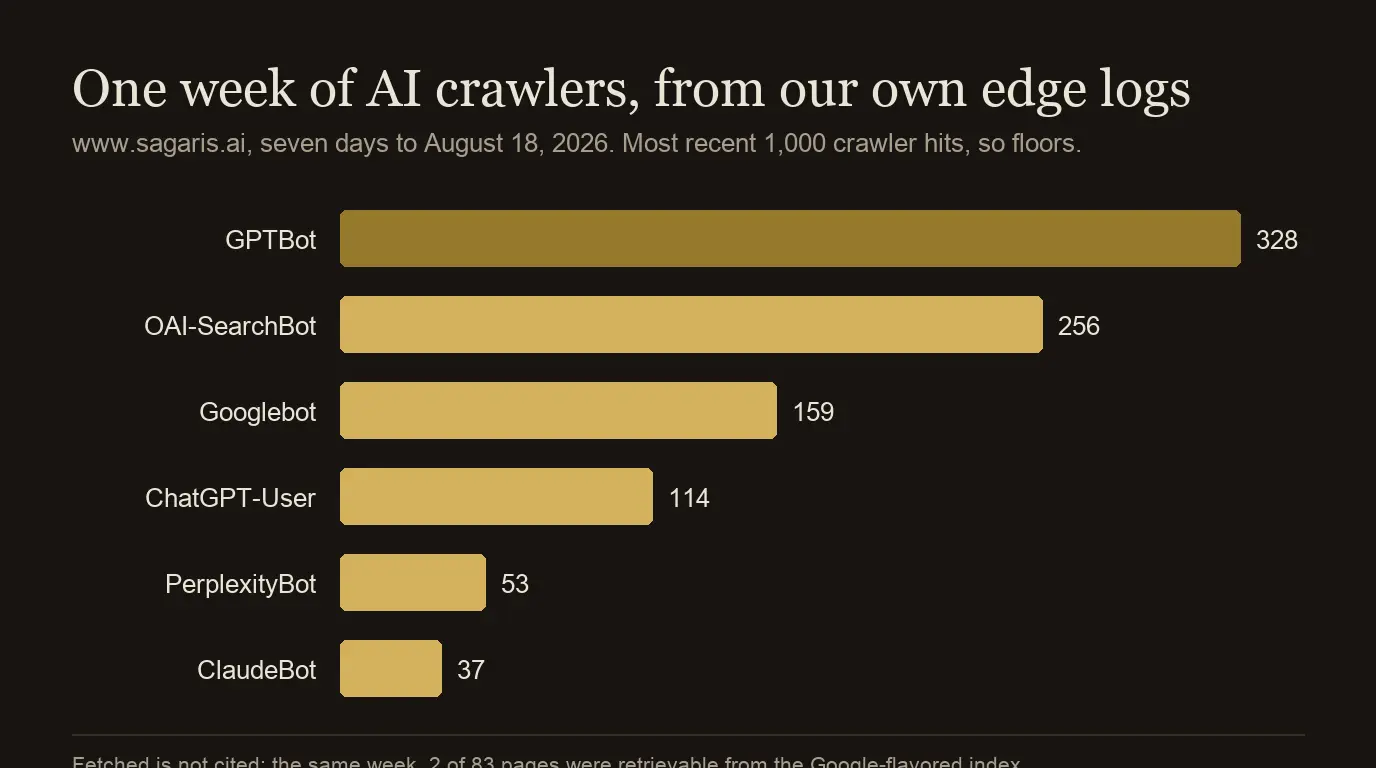
In the seven days to August 18 we read our own edge logs and counted who actually visits www.sagaris.ai. In the most recent 1,000 crawler hits, GPTBot came 328 times, OAI-SearchBot 256, Googlebot 159, ChatGPT-User 114, PerplexityBot 53 and ClaudeBot 37. The sample caps at 1,000, so every number is a floor. The surprise was not the volume. It was how little the volume turns out to buy.
The numbers come from Cloud Run request logs, filtered on the crawlers' own user-agent tokens, the same tokens our robots.txt names and allows. No analytics script sees these visits and no dashboard reports them, which is why most sites have no idea what their machine traffic looks like. A week of logs and one query is the whole instrument.
The tokens matter because they do different jobs. OAI-SearchBot builds the index that answers ChatGPT search queries. GPTBot collects training data. ChatGPT-User is neither: it fires when a real person asks a question and the assistant fetches a page on the spot to answer it. PerplexityBot indexes for Perplexity's answers, ClaudeBot collects for training, and Googlebot is the one everyone already knows. Blocking them is not one decision but several: block a search-index crawler and you vanish from that engine's answers; block a training crawler and you have only kept your words out of the next model.
The 114 ChatGPT-User fetches are the line we keep rereading. One hundred and fourteen times in a week, a person asked a question and the assistant decided a page of ours might hold the answer, fetched it and read it on the spot. That is not crawl budget. That is an audience, arriving one question at a time.
Here is the uncomfortable half of the ledger. The same week those crawlers fetched us a thousand times, we probed the public engines for the queries our pages answer and found ourselves cited exactly nowhere we could detect. And only 2 of our 83 sitemap pages were retrievable from the Google-flavored index at all. Access was never the problem: of six sites we scanned with the same instrument, ours had the cleanest crawler access. Retrieval interest was never the problem either, as the log counts show. The gap is downstream, where engines decide which fetched page is worth quoting and which brand the answer should name.
That decision leans on surfaces that have nothing to do with your robots.txt: review platforms, comparison articles, videos, the places where third parties talk about you. A crawler can visit a thousand times and still have nothing independent to quote.
First, the quotable window. Answer engines that quote a page tend to quote the first couple hundred characters after the H1 and ignore the meta description entirely. We rewrote the opening of every money page so the sentence a machine would lift actually says what the product is and what it costs: the dialer page now opens with the dialer and the published $499 seat price, the platform page opens with the category and the price, and so on across the CRM, receptionist, SMS and coach pages.
Second, the category finally has a definition page. We used AI Sales Operator without writing down what we meant by it, which left our reading of the phrase to whoever felt like defining it. What is an AI Sales Operator now exists as one page that says it plainly, and it is the page every future mention should point at.
Access is table stakes. The competition is for the sentence after the H1.
Just as deliberate is what we did not do. We did not polish llms.txt, chunk our pages into fragments, or bolt on more structured data, because the measured evidence and the search engines' own published guidance this summer say those are not the levers. The levers are being indexed, being quotable, and being talked about by someone other than yourself.
The logs will tell us whether it worked. The crawlers already come every day; the question the next month answers is whether the answers start saying our name. We will publish what the logs show either way.
Sources
Thirty minutes, your own data, no setup.
Join the waitlist and we will be in touch when self-serve sign-up opens.